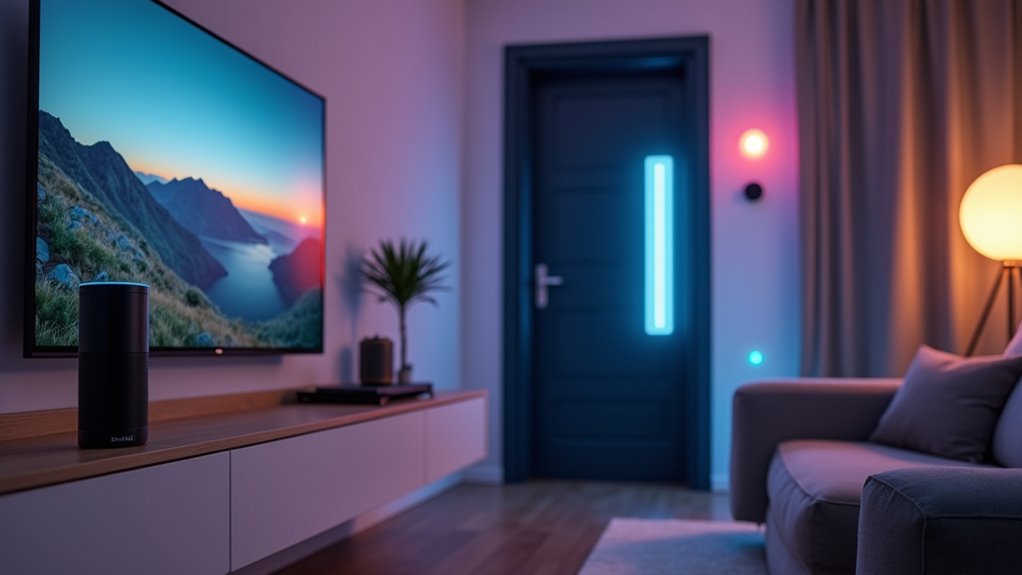
Uprising. That’s what’s happening in our homes right now. Smart home hubs are staging a quiet transformation, and by 2029, they’ll control everything from your morning coffee to your bedtime routine. The numbers don’t lie—the global smart home market is exploding from $84.5 billion in 2024 to a projected $116.4 billion by 2029.
Your hub isn’t just managing your lights anymore. It’s becoming the brain of your house, orchestrating security systems, HVAC, appliances, and entertainment with AI-driven precision. Thanks to artificial intelligence and generative AI, these devices are learning your habits faster than your spouse does. They’re automating routines, optimizing energy consumption, and scheduling your entire day without breaking a sweat. These hubs will maintain local control of your devices even during internet outages, ensuring your smart home remains functional at all times.
The real game-changer? Interoperability. Remember when your Samsung fridge couldn’t talk to your Apple TV? Those days are numbered. Major players like Amazon, Apple, Google, and Samsung are finally playing nice, creating unified ecosystems where devices actually communicate. Matter and Thread protocols are making cross-platform compatibility a reality, not a pipe dream. The sheer scale of this transformation is staggering, with the market expected to grow by $255.2 billion between 2025 and 2029 alone.
North America is leading this charge with an aggressive 18.3% growth rate, while Asia-Pacific is sprinting ahead at 8.4% due to rapid urbanization. The US market alone will hit $26.36 billion by 2029. That’s a lot of smart toasters.
But here’s where it gets interesting—and slightly terrifying. Security concerns are driving adoption, yet privacy worries are simultaneously pushing manufacturers to beef up cybersecurity features. Biometric authentication and two-factor verification are becoming standard, because apparently we need our refrigerators to recognize our fingerprints now. Retrofit installations are showing explosive growth at 8.4% annually as existing homeowners upgrade their spaces without major renovations.
The business model is shifting too. Subscription services and cloud integration are the new money makers. Companies are bundling devices with hubs and services, creating ecosystem lock-in that would make telecom companies jealous.