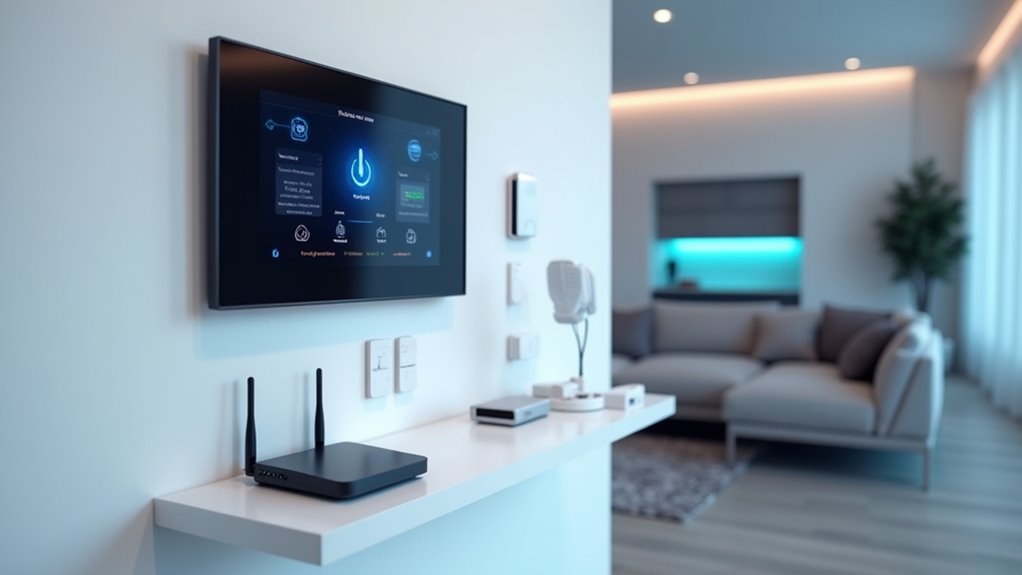
While everyone’s arguing about privacy and robots taking over, smart home devices have somehow crept into nearly half of American households with internet access. The numbers tell the story. In 2024, the global smart home market hit $127.80 billion—and if projections hold, it’s racing toward $537.27 billion by 2030. That’s a 27% annual growth rate, which seems almost absurd. Actually, some analysts project even more aggressive growth—the market could expand by USD 255.2 billion from 2025-2029 alone, with a CAGR pushing 23.5%. People can complain all they want about Big Tech watching them brush their teeth. They’re still buying these gadgets like crazy.
Smart TVs dominate, sitting in 57% of American homes. But here’s what’s wild: smart speakers have reached 79% of households. Think about that. These aren’t luxury items anymore—they’re basically appliances. The average person probably talks to Alexa or Google Assistant more than they talk to their neighbors.
Smart speakers aren’t luxury items anymore—they’re appliances people talk to more than their neighbors.
Meanwhile, smart lighting systems control 26% of the global device market, and security cameras take up another 23%. People want convenience. They want it now.
The real kicker? Eighteen percent of connected households own six or more smart devices. Six. We’re not talking tech enthusiasts or Silicon Valley types here. These are regular people who discovered that, yeah, turning off lights with their voice beats getting up from the couch every time.
Smart kitchen appliances? They’re in 41% of homes. Smart door locks protect 8.2% of American houses—though that number feels like it should be higher, given how often people forget their keys. Even smart smoke detectors have hit 7.6% adoption, which makes sense when you consider nobody wants to climb on a chair at 3 AM to stop that chirping.
Energy efficiency appears to drive a lot of this. Smart thermostats and lighting systems actually do cut utility bills—not just marketing fluff. They reduce carbon footprints too, which matters to people who care about that stuff. Smart plugs can actually cut off power to energy-draining appliances that silently consume electricity even when not in use.
And here’s something interesting: property values can jump up to 5% just from having these devices installed. That’s real money, not theoretical benefits.
The pandemic accelerated everything, naturally. People stuck at home started controlling everything through their phones because, well, what else was there to do? Remote monitoring became normal overnight. AI assistants learned daily routines and automated them—sometimes creepily well, sometimes hilariously wrong.
Sure, there are integration headaches between different brands. Not everything plays nice together, and anyone who’s tried to connect a Samsung fridge to an Apple HomeKit knows the pain. But consumers don’t seem to care much. They just buy more adapters. The wireless segment dominates protocol choices anyway, since nobody wants to tear open walls for hardwired systems.
North America owns 35.62% of the global market share, which shouldn’t surprise anyone. The U.S. market alone was worth $36.38 billion in 2024 and supposedly will hit $403.09 billion by 2034—though predicting ten years out feels optimistic in tech.
Even smart home gyms found their way into 2% of American homes, presumably gathering dust next to the regular exercise equipment. The invasion is complete. Resistance was never really an option.