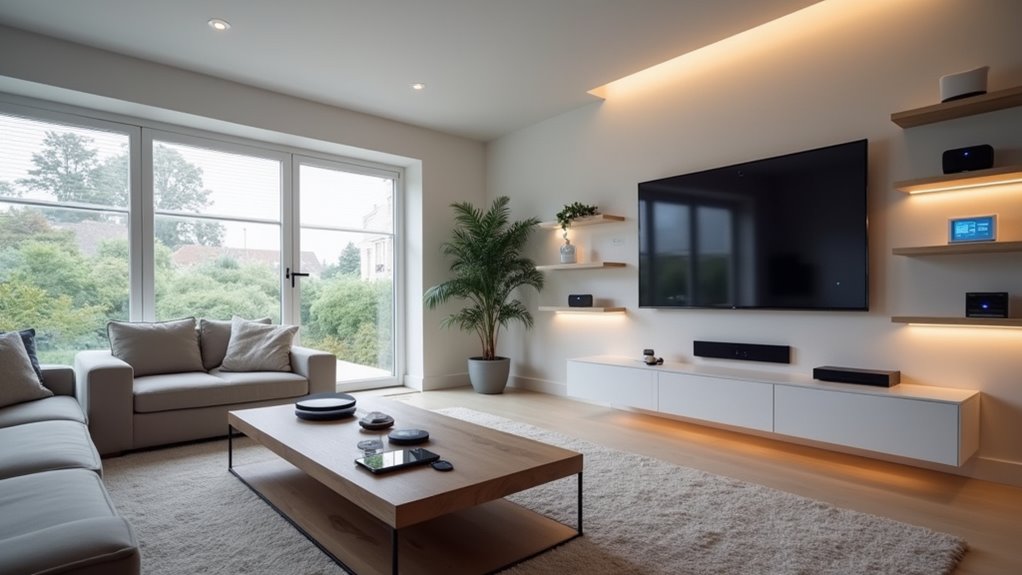
The global home automation market isn’t exactly struggling. Valued at USD 57.71 billion in 2026, it’s projected to hit USD 80.73 billion by 2032, growing at a 5.8% CAGR. Solid numbers. Not exactly jaw-dropping, but solid.
The global home automation market is sitting at USD 57.71 billion in 2026, heading toward USD 80.73 billion by 2032. Solid. Not spectacular. Solid.
Here’s where it gets interesting, though. Some alternative projections put that 2032 figure at USD 268.97 billion, with a 15.4% CAGR. That’s a massive difference. Like, embarrassingly massive. Analysts can’t even agree on the ballpark, let alone the seat.
The U.S. market alone sat at USD 35.8 billion in 2024 and is forecasted to reach USD 118.9 billion by 2032. Americans, apparently, really want their lights to turn on automatically. The South region is growing fastest domestically, which probably surprises nobody.
Asia Pacific is the real story globally. Highest projected CAGR at 7.4%, fueled by rapid urbanization across China, India, Japan, and Southeast Asia. Rising incomes, more residential construction, more people wanting smart devices. Simple math. The region isn’t slowing down anytime soon.
Multi-family residential properties dominated with 54.8% market share in 2025. Apartment buildings and condos, not single-family homes, are leading adoption. Remote management capabilities make sense when landlords oversee dozens of units simultaneously. Convenience wins.
Entertainment and controls represent the largest product segment. Smart TVs, streaming devices, multi-room audio. Nobody’s shocked. People will automate their Netflix before they automate their thermostat, apparently. Lighting and HVAC controls follow behind.
The growth catalysts are pretty standard. IoT advancements, high-speed internet expansion, government incentives for energy-efficient homes, and DIY systems available on e-commerce platforms. Lower barriers mean more buyers. AI-driven automation and voice control are genuinely improving user experience too. Sensor technology and machine learning are enabling adaptive, personalized automation that adjusts to individual household behaviors over time. Players like Johnson Controls, Honeywell, and Apple are leaning hard into this shift, with common strategies including product launches, acquisitions, and partnerships to capture share before the market matures. Beyond convenience, consumer interest is increasingly gravitating toward energy efficiency features, with smart thermostats alone capable of reducing heating and cooling costs by 10-15%.
Now the catch. With projections ranging from USD 81 billion to nearly USD 269 billion by the same year, nobody truly knows where this market lands. That’s not reassuring for anyone trying to make informed decisions. The growth is real. The trajectory is real. The exact destination? Genuinely unclear.