
While most people are still figuring out how to program their coffee makers, the smart home market is quietly exploding into a financial juggernaut. The global market value is projected to hit $149.43 billion in 2025. That’s real money, not Monopoly cash.
The smart home market is exploding into a $149.43 billion financial juggernaut while people struggle with coffee makers.
But wait, there’s more. By 2032, analysts expect the market to balloon to $633.2 billion, growing at a staggering 22.9% annually. Some forecasts push even further, suggesting the market could reach $1.4 trillion by 2034. That’s trillion with a T. The U.S. alone is sitting at $23.72 billion in 2024, with projections reaching $403.09 billion by 2034.
What’s driving this madness? Technology advancements, obviously. IoT devices are multiplying like rabbits in spring. Security tech is getting smarter, devices are getting cheaper, and people actually want this stuff now. Energy management and sustainability aren’t just buzzwords anymore – they’re selling points that actually move products. The expansion is fueled by strategic partnerships among major vendors that enhance innovation and improve device compatibility across different platforms.
North America leads the charge because Americans love their gadgets and have money to burn on them. Asia-Pacific is catching up fast thanks to urbanization and growing disposable incomes. Europe’s regulatory frameworks are actually helping, not hurting, adoption rates.
AI assistants like Alexa, Google Assistant, and Siri are running the show now. These digital butlers learn your habits, anticipate your needs, and somehow know when you want your lights dimmed before you do. Machine learning and natural language processing are making systems genuinely intelligent, not just programmed. The number of digital voice assistants is predicted to double from 4.2 billion in 2020 to 8.4 billion by 2024.
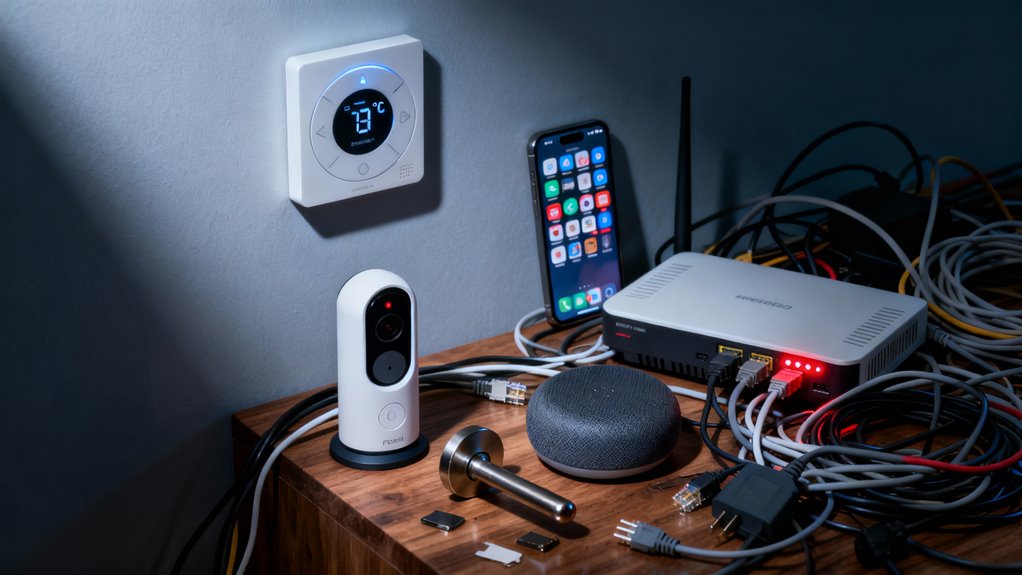
Of course, it’s not all smooth sailing. Different brands still can’t play nice together – try connecting your Samsung fridge to your Apple ecosystem. Privacy concerns are legitimate when every device is collecting data about your bathroom habits. Security vulnerabilities make some people nervous about hackable door locks. The threat is real considering approximately 80% of IoT devices are vulnerable to various forms of cyberattacks.
The big players are predictable: Amazon, Apple, Google, Samsung, Bosch, Honeywell. They’re forming strategic alliances and buying up smaller companies faster than you can say “smart thermostat.”
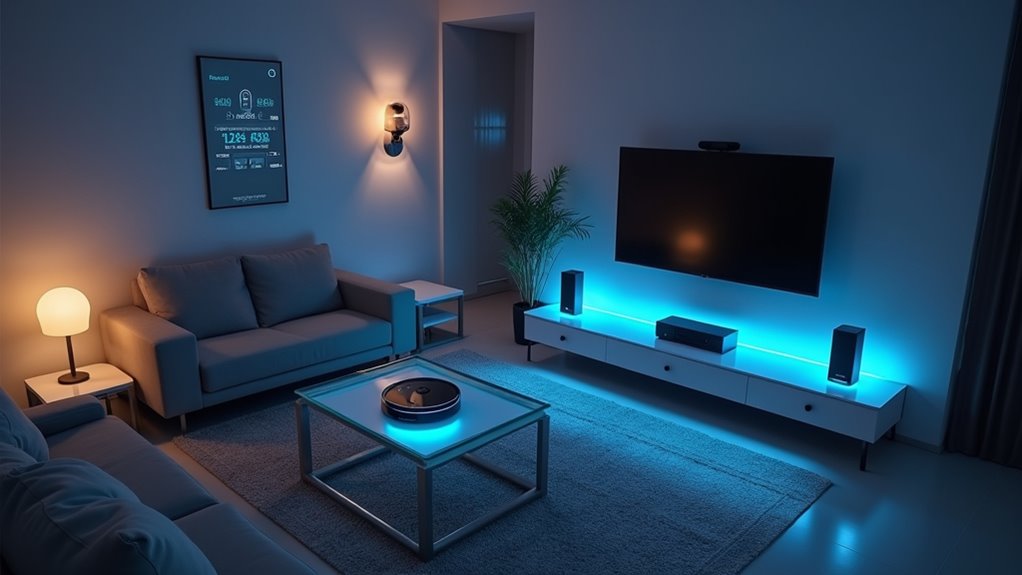
Consumer adoption keeps accelerating. People want convenience, safety, and lower energy bills. Voice control is becoming second nature. Smart lighting, security systems, and energy management aren’t luxury items anymore – they’re becoming standard household features. The connected home transformation isn’t coming. It’s here.