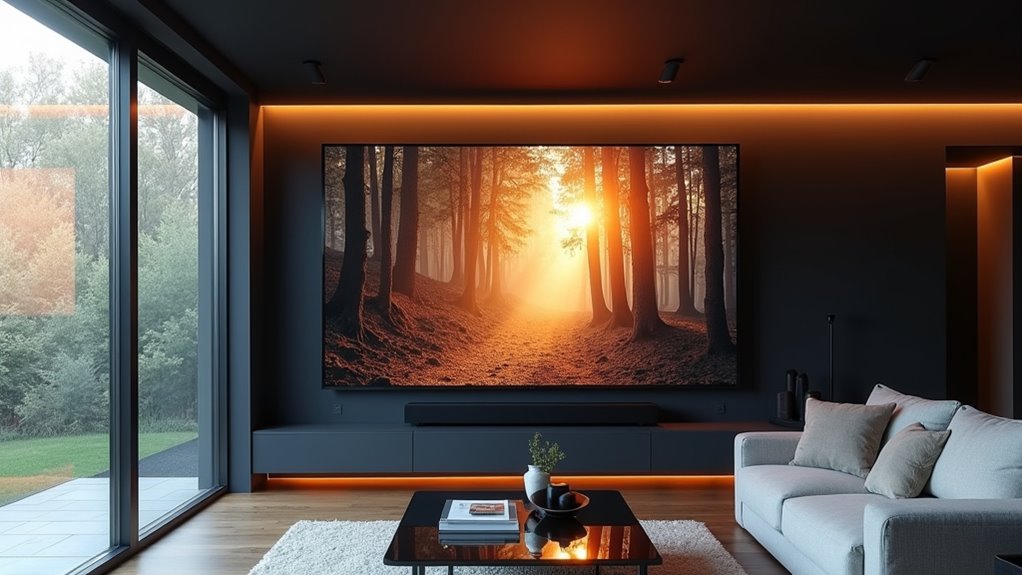

The television just hit 8,000 nits. Hisense’s RGB-MiniLED UX TV—a 116-inch monster—makes everything else look dim by comparison. Most OLEDs? They’re struggling to hit 1,000 nits. Even decent MiniLED TVs tap out around 2,000. We’re talking four times brighter than what most people consider blinding.
Now, the proprietary MiniLED technology isn’t just about scorching retinas. Somehow it’s delivering deep blacks alongside that retina-searing brightness, which shouldn’t really be possible, but here we are. The Hi-View AI Engine X appears to be doing the heavy lifting, optimizing every single frame in real-time.
No more banding. No more washed-out colors when sunlight floods your living room. Black nanocrystal layers cut down reflectivity—because apparently, regular screens weren’t cutting it anymore.
At 116 inches, calling this a TV feels wrong. It’s a wall. The company captured 58% global share in large-screen TVs over 100 inches in H1 2025, so they clearly know what they’re doing with massive displays. Interestingly, Hisense previously launched an 8K ultra short throw projector with a bundled 120-inch screen, pushing the boundaries of what home cinema could achieve.
That said, Hisense’s TriChroma Laser Cinema solutions push things even further, projecting images up to 200 inches. Traditional TVs get blurry and sad at these sizes. Not this one. The image stays sharp, colors stay vibrant. With IMAX Enhanced support, you’re essentially getting theater-quality visuals minus the sticky floors and twelve-dollar sodas.
The AI isn’t just marketing fluff either. IntelliSense sensors seem to manage brightness and power consumption automatically, adjusting settings based on what’s playing and where the TV sits in your room. Those annoying halos around bright objects that plague lesser displays? The system reduces them considerably.
Even Hisense’s own U7 and U8 models—which peak at 3,000 to 5,000 nits—look outdated by comparison.
Dolby Vision IQ, HDR10+, and 95% BT.2020 color space coverage round out the specs. On the audio side, Dolby Atmos and DTS Virtual X handle the wraparound sound everyone pretends they don’t need until they actually hear it.
There’s Filmmaker Mode too, preserving the director’s vision—assuming anyone cares about artistic intent when explosions are involved.
Hisense already dominates the large-screen TV market globally, and now they’re setting the bar impossibly high at IFA 2025. Sure, their 10,000-nit microLED prototype is waiting in the wings, but that’s likely not ready for prime time.
This 8,000-nit beast though? It’s real, it’s here, and it makes traditional TVs look like cave paintings.