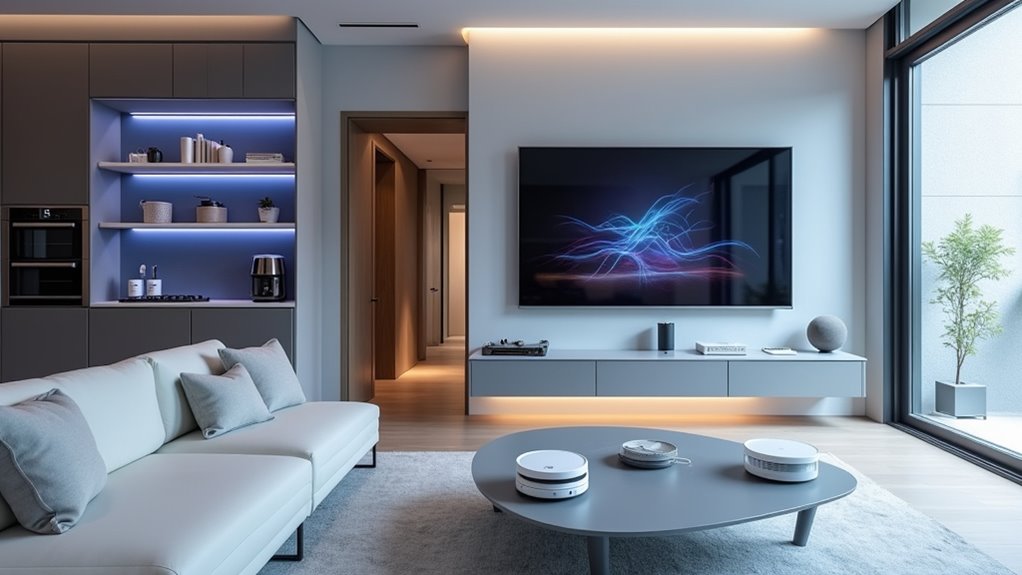
While most markets crawl toward digital transformation, China’s smart home sector has sprinted past the finish line. The numbers tell a jaw-dropping story. From 2016 to 2025, this market is exploding from $48.7 billion to a projected $89.8 billion—a compound annual growth rate that hovers around 15-16%.
That’s not growth. That’s a rocket launch.
By 2023, China’s smart home market had already crossed 715 billion yuan. Over 78 million households now live with smart products buzzing around their homes. Apparently, turning on lights manually is so last decade.
By 2023, over 78 million Chinese households ditched manual light switches for smart home tech worth 715 billion yuan.
What’s driving this frenzy? Money and cities, mostly. Rising urbanization and disposable incomes create the perfect storm for tech adoption. Add 5G infrastructure and China’s obsession with mobile phones, and you’ve got a digital transformation on steroids.
Smart appliances dominate the battlefield, claiming nearly 50% of industry turnover. Kitchen gadgets, vacuum robots, and small household appliances rule the roost. Meanwhile, energy management sits in the corner with a measly $1.7 million in revenue. Someone clearly didn’t get the memo about saving electricity.
The real game-changer? Scenarios over standalone gadgets. Nobody wants just a smart speaker anymore. They want entire ecosystems. Haier, Xiaomi, and Huawei figured this out early, launching integrated offerings that make everything talk to everything else. Rice cookers chatting with air purifiers. TVs coordinating with kitchen appliances. It’s like a digital dinner party. Trade-in policies are accelerating this shift toward interconnected smart home systems as consumers replace older appliances with intelligent alternatives.
AI-powered voice assistants and smartphone integration sealed the deal. Why walk to a light switch when you can bark orders at your ceiling? Wi-Fi 6, Bluetooth, and proprietary protocols handle the heavy lifting while companies like Sanyiniao and Huawei package it all into neat, lifestyle-focused bundles.
Consumer behavior shifted hard. People now think in terms of connected living scenarios rather than individual devices. Convenience, security, and energy efficiency drive purchase decisions. Though lower-income households still face adoption barriers because smart homes aren’t exactly budget-friendly. High initial investment costs continue to deter middle and lower-income families from jumping into the smart home revolution.
The competition is fierce. Schneider Electric, Emerson, ABB, Honeywell, Siemens, and Signify duke it out alongside domestic champions. Innovation happens fast when everyone’s fighting for market share.
China’s smart home transformation isn’t slowing down anytime soon. Custom routines simplify complex household tasks into single commands, making them a particularly attractive feature for tech-savvy Chinese consumers.


