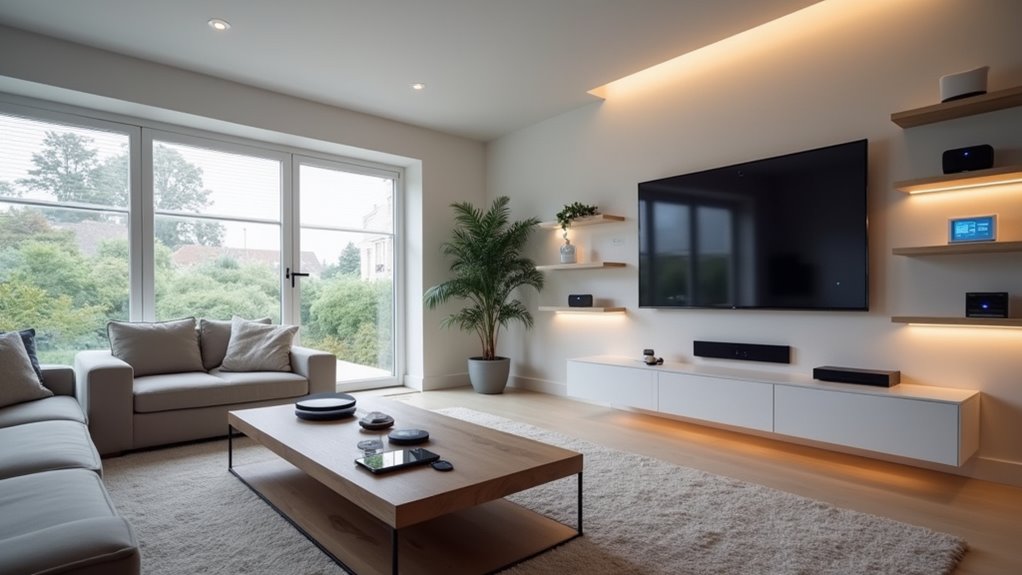
While everyone’s been arguing about whether robots will take our jobs, smart homes have been quietly plotting their own takeover. The market’s set to explode from $106 billion in 2023 to $300 billion by 2035. That’s a 9% annual growth rate, though some dreamers think it’ll hit a trillion. Sure, Jan.
Here’s what kills me: Most people still flip regular light switches like cavemen. Fumbling for keys every single day. Manually adjusting thermostats when they get chilly. Yet tech companies are already building AI-powered homes that seem to predict what temperature you want before you even realize you’re cold. The disconnect is almost comical.
Most people still flip light switches like cavemen while tech companies build homes that predict your needs before you do.
IoT devices? They’re multiplying like rabbits. Smart locks that recognize your phone as you approach. Cameras that distinguish between your cat and an intruder. Lighting systems that dim themselves for movie night. It’s all part of this massive wave, and consumers say they want it – the convenience, the safety, the lower energy bills. Makes sense. Who doesn’t want their house to automatically turn off forgotten lights? Or a thermostat that actually learns when you leave for work?
The real drivers might be boring but they’re powerful. Government incentives are pushing adoption. Energy efficiency regulations keep tightening. And let’s face it – the endless human desire to feel safe probably isn’t going anywhere. On top of that, 5G and edge computing are making these devices actually responsive instead of laggy nightmares. Remember waiting five seconds for your smart speaker to process “turn off the lights”? Those days appear to be dying.
Right now we’re stuck in early adoption, mostly basic automation and security systems. Security and access controls are expected to dominate with a 27.3% market share while wireless protocols lead connectivity at 55.8%. But by 2025, things could get interesting. Prices should drop enough for regular people to start buying in. Then by 2030, the premium crowd likely gets their fully integrated ecosystems – everything talking to everything else. Your fridge notices you’re out of milk and adds it to your shopping list. The car starts warming up the moment your morning alarm goes off.
Voice assistants have already infiltrated everywhere, managing our entertainment systems and HVAC like digital butlers. Entertainment devices currently dominate the market due to increased demand for smart displays and streaming devices. Smart furniture‘s becoming a thing – beds that track your sleep, desks that remind you to stand. Home healthcare monitoring too, which might actually matter as populations age.
Meanwhile, the top 30 companies are throwing money at AI and IoT convergence like it’s going out of style. You can slice this market every way possible – by type, connectivity, price, geography. But what seems to matter is pretty simple: people want their homes smarter, safer, and cheaper to run. They want to control everything from their phones. The investment ranges widely too, from DIY setups costing a few thousand dollars to comprehensive systems reaching six figures for larger homes.
Wellness features are increasingly popular. And apparently, they’re willing to pay $300 billion for all of it.