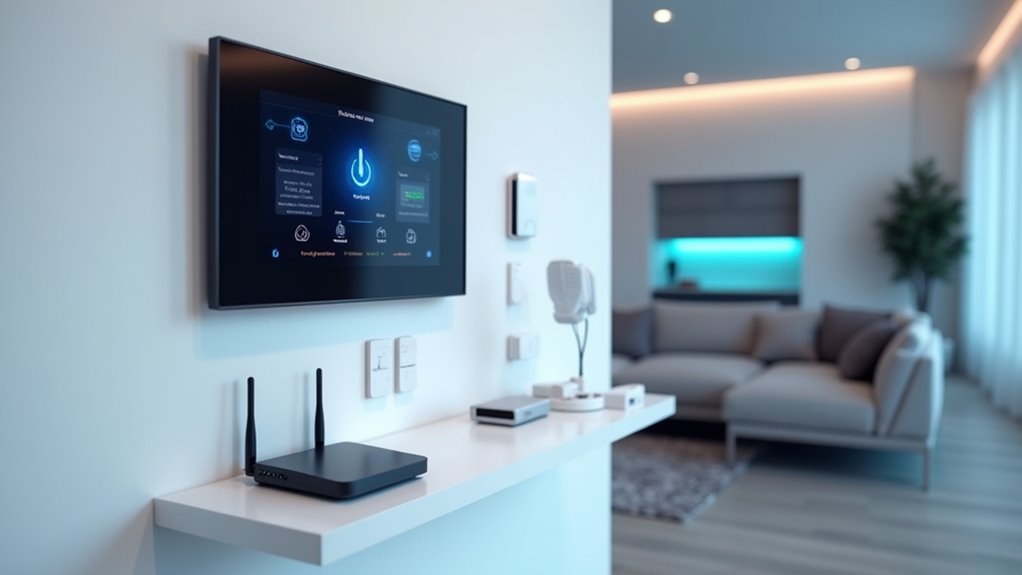
At the heart of any well-run smart home, there’s usually one piece of tech that nobody talks about enough — the smart button. It’s small. It’s quiet. And it’s doing more heavy lifting than most people realize.
Smart buttons are wireless, battery-operated devices that trigger automation sequences through a simple physical press. Single press. Double press. Long press. They handle it all. Three main types dominate the market: the Samsung SmartThings button running ZigBee, the Aeotec Nanomote Quad on Z-Wave, and the Flic Button using Bluetooth. Different protocols, different strengths.
Single press. Double press. Long press. Smart buttons handle it all — wireless, battery-operated, and built for effortless automation.
Here’s the thing about wall-mounted light switches — they only control main lights and basic power flow. That’s it. Lamps, accent lighting, secondary sources? Good luck. Smart buttons fill that gap without any rewiring or renovation drama. They mount magnetically and go anywhere in the home. No electrician required.
For households where not everyone is tech-savvy, this matters enormously. Voice commands frustrate some people. Apps frustrate others. A physical button that just works? That’s genuinely useful. It gives everyone in the home access to complex automation sequences without needing a tutorial. Smart buttons also reduce the need for multiple dedicated apps, since a single press can replace what would otherwise require navigating several brand-specific interfaces.
One press can activate a predetermined scene across multiple device types simultaneously. Lights, locks, thermostats, security cameras — all responding at once. ZigBee handles this fast, with near-instantaneous command execution and support for thousands of devices. Z-Wave keeps smart locks and water leak sensors reliably connected. Bluetooth handles shorter ranges but improves with hub support.
Google Home added smart button trigger support as part of recent automation updates, and buttons now integrate with geofencing, motion detection, and learning algorithms. They work alongside existing ecosystems rather than replacing them. Central hubs process automation locally, which also improves privacy.
Energy management is another underrated win. Remote power control for fans, lamps, and heaters. Scheduling. Smart thermostat integration. These aren’t flashy features, but they add up. Choosing open standards like Z-Wave and Zigbee ensures long-term system relevance as technology evolves and new devices enter the market. Smart Shield Systems serves residential and commercial clients in the San Diego area with advanced security and automation installations that bring these systems together under one roof.
Smart buttons aren’t glamorous. Nobody’s posting unboxing videos with dramatic music. But for a smart home that actually functions smoothly day-to-day, they’re arguably indispensable.