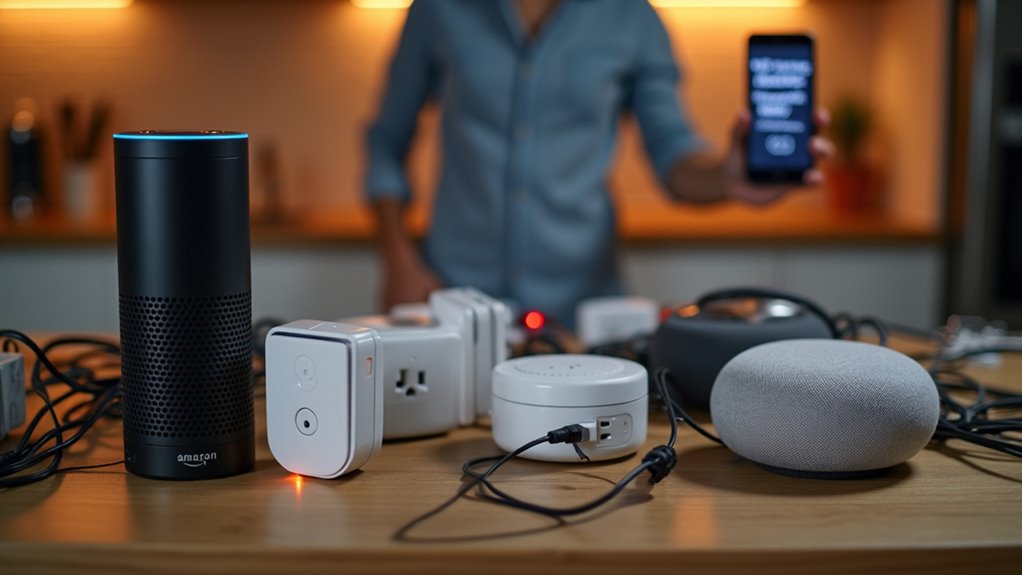
Five everyday appliances might turn into fire hazards when paired with smart plugs. Sure, the convenience of controlling devices remotely sounds great—until you’re dealing with smoke damage.
Let’s start with ranges and stoves, which already cause most household fires in America. They’re behind 53% of cooking fires and a staggering 88% of cooking fire deaths. Electric ranges? Those appear to be even riskier, with twice the likelihood of starting fires compared to gas models. Here’s where smart plugs become particularly concerning: remote control means nobody’s physically present when grease starts to splatter or that dish towel drifts too close to the burner. Unattended cooking already tops the list of kitchen disasters. Smart plugs just make it ridiculously easy to forget you left something on the stove.
Remote control means nobody’s physically present when grease starts to splatter or that dish towel drifts too close.
Refrigerators seem harmless enough—just humming away in the corner. But those compressors and relays generate serious heat, especially in older units that may already be struggling. The thing is, smart plugs can mess with power cycles, and refrigerators really don’t handle sudden power cuts well. They weren’t engineered for that kind of on-off treatment.
Remember when 1.6 million Maytag units got recalled in 2009 for relay failures? That was before anyone even thought about smart plugs. These fires might be rare, but when they happen, all that plastic and insulation creates a fast-spreading blaze.
Then there are dishwashers—heating elements plus water. What could possibly go wrong? Well, GE had to recall 2.5 million units back in 2007 after internal shorts sparked fires. Running them while you’re out seems efficient, right up until faulty wiring meets a leaking seal.
Smart plugs let people schedule overnight cycles or start them from the office. Problem is, nobody’s around to notice that burning smell or see water pooling where it shouldn’t. Even with Xiaomi’s smart home ecosystem offering automation capabilities, their devices can still be susceptible to security vulnerabilities that might affect safe operation.
Clothes dryers? They caused 13,723 fires in one analysis. Could be lint buildup, might be broken thermostats or faulty switches—take your pick. Smart plugs without proper thermal cutout features likely make things worse. Remote operation means nobody’s checking that lint trap or catching that distinctive burning odor before it’s too late.
Even microwaves pose risks, averaging $5,500 in damage per incident when things go south. Door latches fail sometimes. Wiring can short out. People schedule reheating through their smart plugs and completely forget what they left inside. Food particles and crumb accumulation in toaster ovens create another overlooked hazard when controlled remotely through smart technology. Toasters should always be unplugged after use, but smart plugs keep them energized and ready to malfunction at any moment.
That metal fork in yesterday’s Chinese takeout? The microwave doesn’t know you’re not home to intervene.
Fire departments respond to hundreds of cooking-related calls every single day. Smart plugs may transform basic appliances into unattended hazards, even if that’s not what manufacturers intended. The convenience is tempting, but watching your house go up in flames? That’s a price nobody wants to pay.