Apple’s HomePod journey reads like a tech soap opera—complete with delays, disappearing acts, and dramatic comebacks. What started as a side project by Mac audio engineers in 2014 has become one of Apple’s most confusing product lines.
The timeline gets messy fast. Apple announced the first HomePod at WWDC 2017, then promptly delayed it until February 2018. At $349, it flopped harder than a fish on dry land. Sure, it sounded amazing, but consumers weren’t exactly thrilled about paying premium prices for a speaker that couldn’t even do stereo pairing at launch.
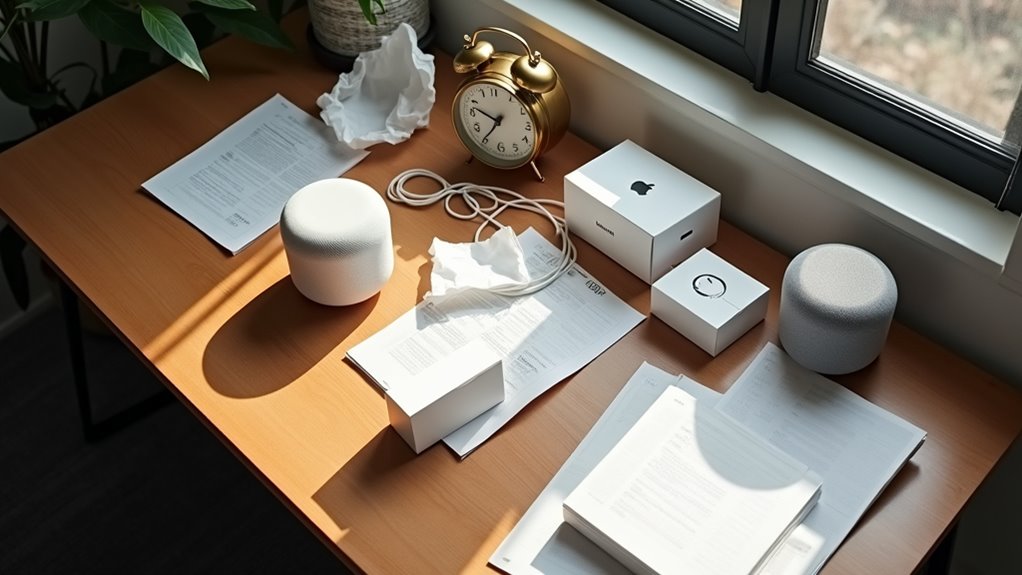
Enter the HomePod mini in 2020. At $99, it finally made sense. Apple had learned something from that original brick’s sluggish sales. The mini packed an S5 chip that actually outperformed the original’s aging A8 processor. Talk about awkward family dynamics.
The mini’s superior chip made the flagship look embarrassingly outdated—classic Apple sibling rivalry at its finest.
Then came the plot twist nobody saw coming. Apple killed the original HomePod in March 2021, just three years after launch. The writing was on the wall—reports suggested devices sold in early 2021 still bore 2018 manufacturing dates. That’s not healthy inventory turnover. After the discontinuation announcement, stock depleted rapidly as customers rushed to secure the last remaining units.
For nearly two years, Apple left a gaping hole in its lineup. No flagship smart speaker. Just the mini holding down the fort. Supply chain issues probably didn’t help, but this felt like strategic confusion more than logistical problems.
The second-generation HomePod finally arrived in January 2023, shipping in February. Apple loaded it with computational audio, Spatial Audio support, and smart home features like temperature sensing. Because apparently, your speaker needs to know if your house is burning down now. Despite reducing both microphones from six to four and tweeters from seven to five, Apple maintained the device’s sound quality through other engineering improvements.
This timeline reveals Apple’s biggest challenge with HomePod—timing. The original came too late and cost too much. The mini arrived three years later when competitors had already claimed territory. The second-generation model launched after another two-year gap, forcing Apple to rebuild market presence from scratch.
Today, both models coexist peacefully. The mini handles entry-level duties while the full-size version tackles premium audio. It only took Apple nine years to figure out what Amazon knew from day one.