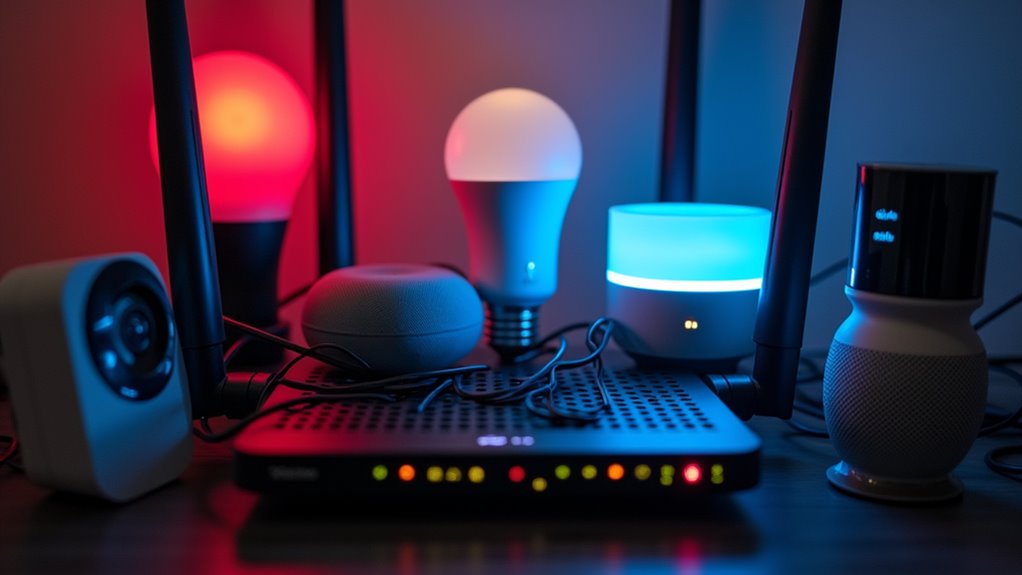
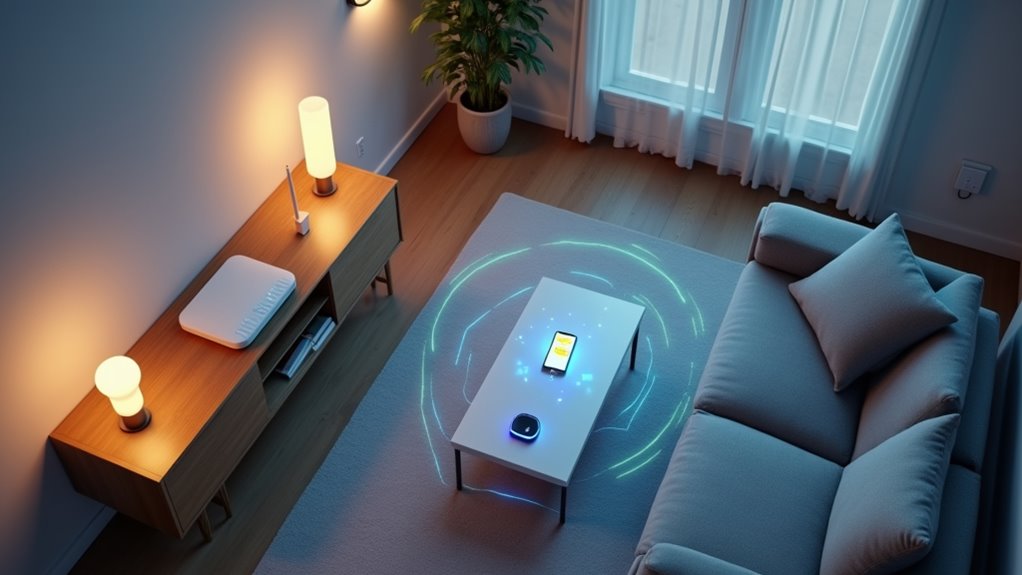
While most homeowners still struggle to get their smart doorbell to connect from the garage, modern smart home devices are quietly extending their reach up to 1.5 miles from the house. That’s not a typo. Your smart home network can now stretch further than most people walk for exercise.
Smart home networks now reach 1.5 miles from your house while most people can’t connect a doorbell in the garage.
This dramatic range expansion comes courtesy of protocols like LoRa, Zigbee, and Z-Wave. These technologies laugh at traditional Wi-Fi limitations. Mesh networks play a significant role too, with devices acting as relay points to bounce signals across vast properties. It’s like a high-tech game of telephone, except it actually works.
The real game-changer is AI-driven device control. Smart assistants now predict what you want before you know you want it. They study your patterns, learn your habits, and adjust everything from lighting to climate automatically. Personalized automation routines are transforming how smart homes adapt to individual lifestyles across these extended networks. Facial and voice recognition make the system personal. The AI even distinguishes between your daily routine and actual security threats, which means fewer false alarms about raccoons.
Centralized hubs like Amazon Echo and Google Nest have become the command centers for this expanded empire. These devices orchestrate complex routines involving equipment scattered across your entire property. Voice commands work seamlessly whether you’re controlling a gate sensor a mile away or adjusting bedroom lights upstairs.
Security benefits are substantial. Advanced motion detection, facial recognition, and instant alerts now cover remote locations that were previously blind spots. Smart locks grant access to visitors at distant gates. Camera systems stream high-resolution video from outbuildings with minimal delay. Two-way audio lets homeowners chat with delivery drivers standing at remote mailboxes.
Energy management spans the entire network too. Smart thermostats optimize climate control in remote workshops or guest houses. Integration with environmental sensors enables automatic adjustments that slash energy costs across multiple buildings. These systems now integrate with renewable energy sources to maximize efficiency across the extended property network. Regular firmware updates ensure these far-reaching smart devices maintain compatibility and security features as technology evolves.
Broadband providers are taking notice as households demand more robust fiber and hybrid networks to support this expansion. The old days of Wi-Fi barely reaching the backyard are officially over. Smart homes now control entire mini-kingdoms, whether residents realize it or not.