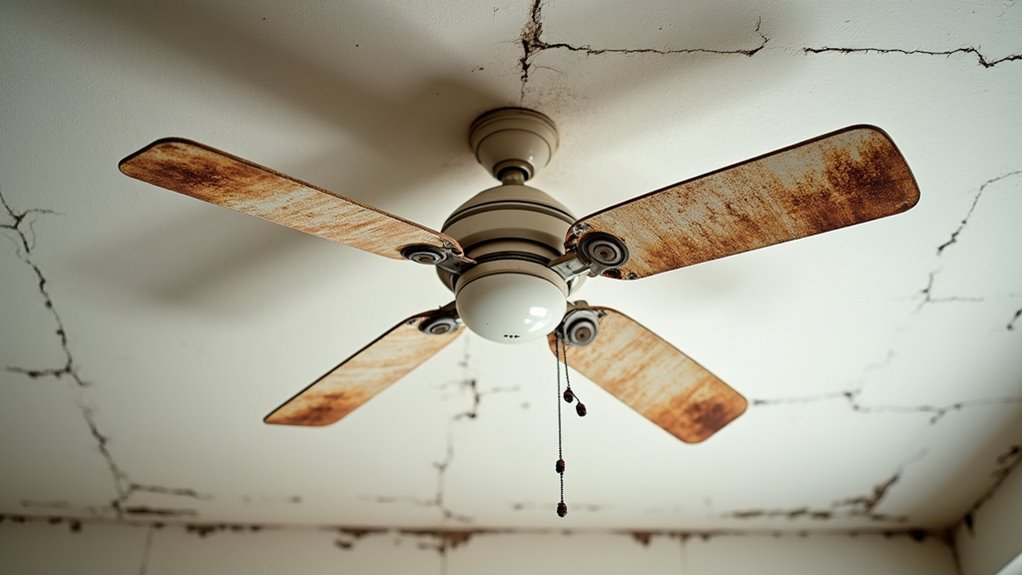

Ceiling fans break down. That wobbling, grinding monster above your head isn’t just annoying—it’s actively making your life worse. And yet, people keep these mechanical disasters spinning for years, pretending everything’s fine while their electric bills climb and their sanity slowly erodes.
That wobbling, grinding monster above your head isn’t just annoying—it’s actively making your life worse.
The problems start small. Maybe a little vibration here, some clicking there. Those loose screws creating rattling noises? That’s just the beginning. Soon you’ll have worn bearings grinding away like fingernails on a chalkboard. Dust accumulates in the motor housing, making everything worse. The whole thing becomes a symphony of mechanical failure.
Electrical issues lurk behind the scenes. Faulty wiring prevents operation entirely, or creates that maddening intermittent functionality where the fan works when it feels like it. Blown fuses and tripped circuit breakers become regular occurrences. Loose connections in switches disrupt everything. Bad capacitors slow blade rotation to a pathetic crawl or kill the fan completely.
The wobbling gets worse over time. Incorrectly installed mounting brackets compromise stability from day one. Unbalanced or warped blades turn your ceiling fan into a small earthquake generator. Mounting screws work themselves loose, creating a shaking mess that threatens to bring down the whole fixture. Poor installation haunts fans for their entire miserable existence.
Performance? What performance. Inefficient motor design reduces airflow while increasing power consumption—the worst of both worlds. Worn capacitors decrease rotation speed until the fan barely moves air. Blades at improper angles impair efficiency completely. A faulty capacitor can completely hinder performance, leaving you with blades that barely rotate despite drawing full power.
Light problems compound the misery. Loose internal wiring kills illumination. Dead bulbs go unchanged for months. Defective light kits require professional servicing that costs more than replacement. Remote controls fail when batteries die, leaving users stranded with a useless ceiling ornament. Dead remote control batteries turn your high-tech ceiling fan into a primitive fixture that requires manual operation of the pull chain.
The maintenance errors pile up. People run fans in empty rooms, wasting energy. Regular dusting gets ignored, affecting balance and lifespan. Moving parts go without lubrication, accelerating bearing wear. Users forget to reverse fan direction seasonally, reducing comfort and efficiency.
Old fans lack modern features like reversible rotation or remote integration. Replacement parts become impossible to find. At some point, breaking free means admitting defeat and starting fresh.