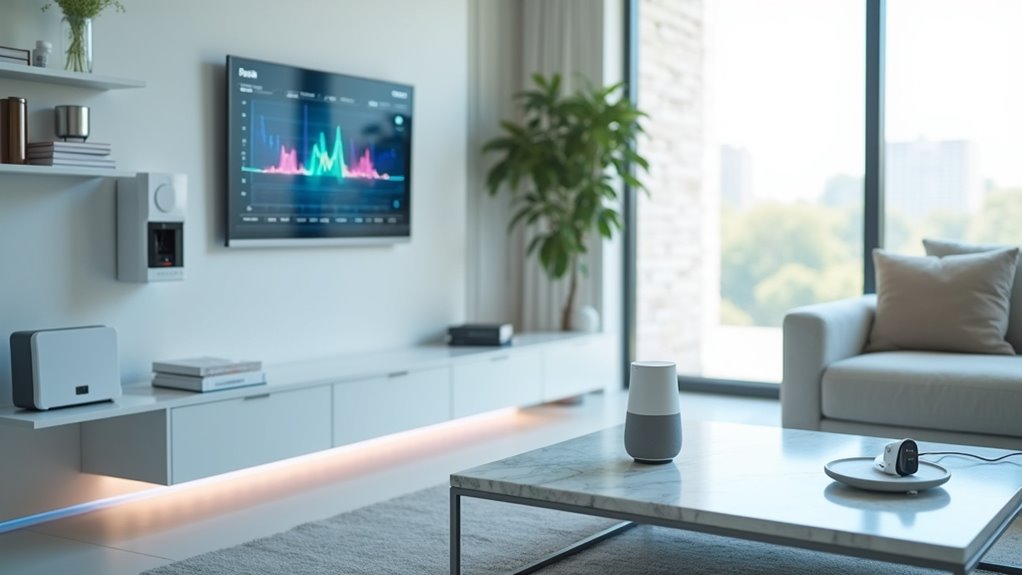
While most people are still figuring out how to use their smartphone’s health app, the smart home healthcare market is about to explode. Projections show it hitting USD 284.86 billion by 2034. Some estimates go even crazier—we’re talking USD 796.03 billion. That’s not a typo.
The smart home healthcare market could explode to nearly USD 800 billion by 2034—whether we’re ready or not.
The growth rate? Somewhere between 23.5% and 28.5% annually through 2034. Look at the U.S. alone: the market jumps from USD 10.48 billion in 2025 to USD 99.55 billion by 2034. North America leads now, but Asia Pacific is charging forward as the fastest-growing region.
Here’s why this matters. By 2030, the global population aged 60 and over hits 1.4 billion. These people don’t want to live in hospitals—they want to age at home. Makes sense, right? Meanwhile, chronic diseases like diabetes and hypertension are everywhere. Remote patient monitoring suddenly seems essential when you consider what readmission costs hospitals these days.
Technology is doing the heavy lifting here. AI-powered home health hubs now appear to predict medical events before they happen. Your smartwatch tracks everything continuously, alongside glucose monitors and oximeters—all feeding data in real time. With 5G networks, that information moves instantly.
Connected medication dispensers remind patients to take their pills at exactly the right time. Fall detection systems? They alert caregivers immediately. Many of these smart health devices can be controlled through a single interface using automation capabilities that trigger responses based on temperature or other environmental conditions.
The money flowing into this space suggests investors see something real. Hellocare.ai grabbed USD 47 million in funding. Cera pulled in USD 150 million. Even Mayo Clinic partnered with hellocare.ai—that’s serious credibility right there.
Universal Health Services adopted AI generative agents for post-discharge patient engagement, while MedTech Nova launched its AI-based SmartVitals Hub, which essentially centralizes device data into one platform.
Healthcare systems love this stuff, and it’s easy to see why: it cuts costs. Value-based care models reward keeping patients healthy at home rather than cycling them through emergency rooms. Remote monitoring appears to reduce readmissions significantly. Patients get timely interventions without leaving their living rooms. The Aging-In-Place segment commands 44.56% market share as solutions for monitoring elderly health data become standard. Abbott’s FreeStyle Libre 3 alone serves 8.4 million users globally, demonstrating the massive scale of continuous glucose monitoring adoption.
The target users are obvious enough—elderly people, individuals with disabilities, anyone managing long-term conditions. Wearable health devices and smart alert systems dominate demand right now. That said, as IoT penetration increases across Europe and Latin America, adoption rates seem likely to climb steadily.
Hospitals aren’t disappearing tomorrow. But the shift is clear. Healthcare is moving home, whether the healthcare system is ready or not.