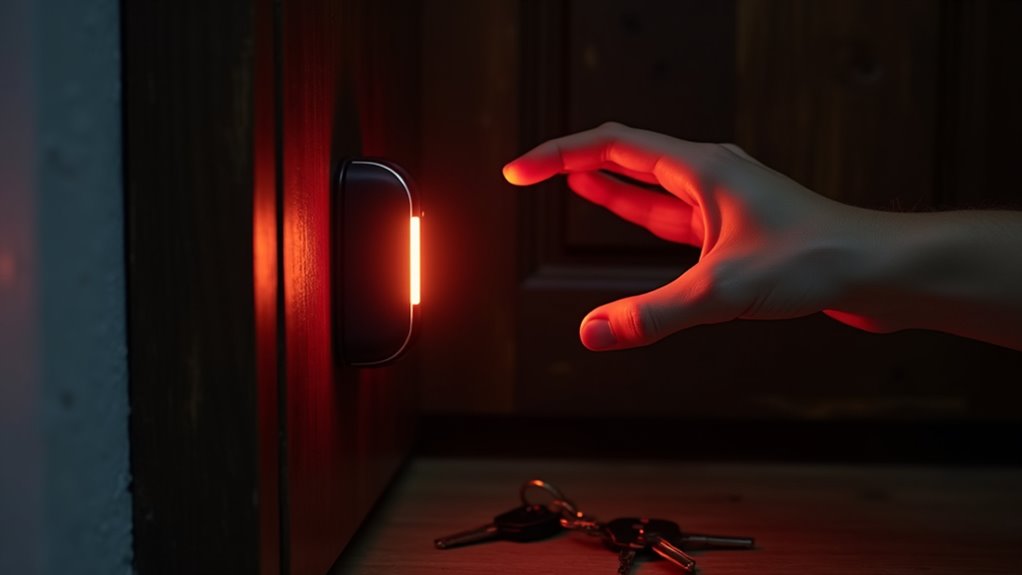
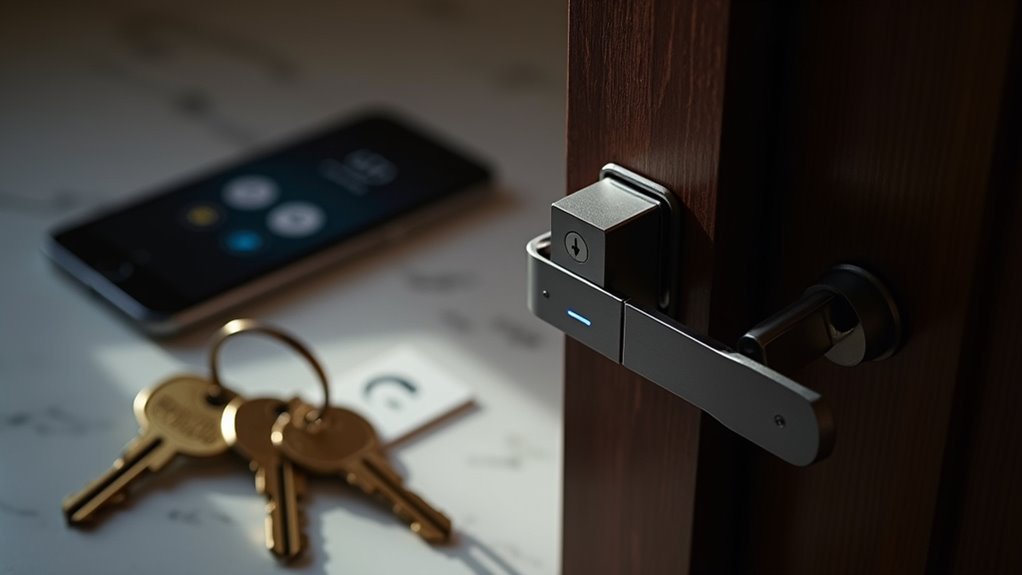
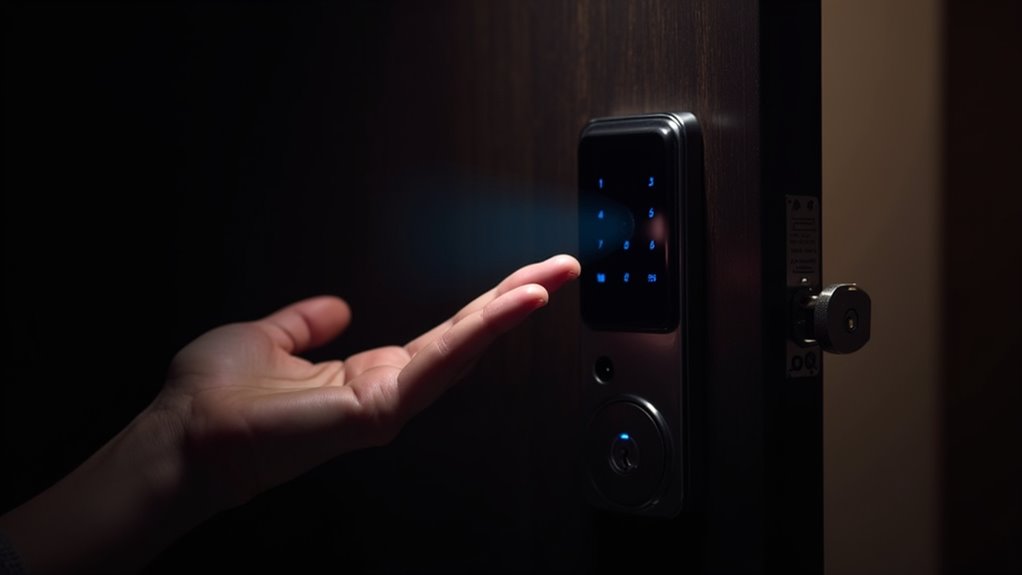
Where exactly did the humble door lock go wrong? Apparently, it wasn’t smart enough. The global smart lock market is racing toward $22.06 billion by 2033, growing at a ridiculous 16% annually. Because nothing says progress quite like turning a simple mechanical device into something that needs Wi-Fi to function.
Take padlocks. They’re exploding from $3.47 billion in 2024 to $20.90 billion by 2034 – that’s 19.68% annual growth. Regular padlocks? Basically extinct at this point. Residential smart locks will jump from $3.4 billion to $8.65 billion over the same period. Seems like every suburban home needs smartphone-controlled deadbolts now.
The U.S. market is particularly nuts, ballooning from $765.85 million in 2023 to $3.44 billion by 2033. What’s driving this madness? Vacation rentals, mostly. Airbnb hosts can’t be bothered to meet guests anymore – remote access is king. Urban centers are eating this stuff up. Multi-family buildings want “scalable access management,” which roughly translates to: landlords love tracking everything.
Airbnb hosts can’t be bothered to meet guests anymore – remote access is king.
Asia Pacific appears to be catching up fast with their smart city initiatives. Europe’s jumping in too, likely thanks to regulatory incentives for smart building tech. Germany, France, and the UK are leading the European charge with their aggressive smart home adoption rates. Even emerging economies are buying in, mostly due to security concerns – which is ironic, considering the security issues these things create.
And about those issues: these locks are hackable. Network breaches, software bugs, privacy violations – pick your poison. Consumers seem to know this. They’re skeptical. Yet somehow they keep buying. Manufacturers scramble to add end-to-end encryption and two-factor authentication, as if that magically fixes everything. Standard home automation setups cost between $700 and $5,000, with high-end systems potentially reaching $150,000 for the truly paranoid. Major players like Kwikset are throwing in features like low battery warnings and customizable user codes to sweeten the deal.
Commercial real estate loves smart locks though. Hotels, retail stores, offices – they’re all converting. Voice assistants might be making it worse. “Hey Alexa, unlock my door” is apparently the future we chose. On top of that, companies are launching subscription services for lock management apps. Monthly fees for door access? Sure, that makes total sense.
Deadbolts dominate the market, followed by lever handles and padlocks. Authentication methods run the gamut: PIN codes, smartphone apps, fingerprints, facial recognition, keycards – whatever works. For connectivity, you’ve got Bluetooth, Wi-Fi, Z-Wave, Zigbee. Pick your poison.
Wi-Fi locks alone are projected to hit $12.49 billion by 2034, because cloud connectivity is apparently essential for the simple act of opening doors.