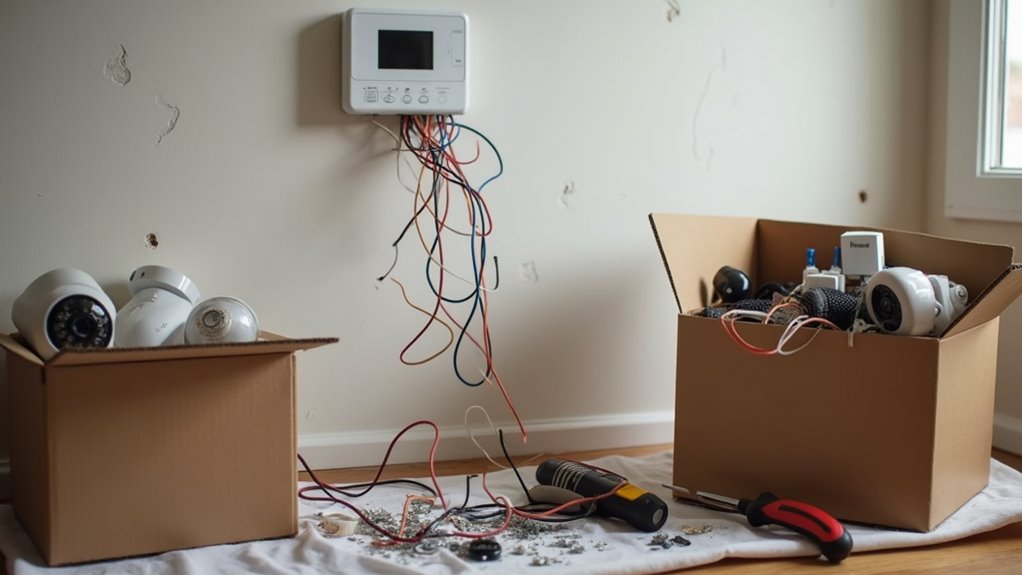
Every smart home starts with good intentions. You grab a smart doorbell on sale. Pick up a voice assistant. Maybe a few bulbs that change colors. Then suddenly you’re juggling seventeen apps, mystery firmware updates, and a house where the lights won’t talk to the thermostat. Welcome to the modern smart home nightmare.
The numbers are telling. American households own an average of 6.2 smart devices now – actually down from eight during the pandemic. People are ditching this stuff. And honestly? It makes sense. Trying to convince Alexa to work with Apple HomeKit while your Zigbee lights throw tantrums at your Z-Wave thermostat isn’t exactly anyone’s idea of a relaxing Saturday. The global smart home market might be racing toward $1.4 trillion by 2034, but individual homeowners? They’re waving the white flag.
People are ditching smart devices while the global market races toward $1.4 trillion—a disconnect that speaks volumes.
Here’s what nobody mentions at Best Buy: these devices seem almost designed to frustrate normal humans. Different protocols everywhere. Competing ecosystems that won’t cooperate. Updates that mysteriously break whatever was working fine yesterday. Google Home gives Apple HomeKit the cold shoulder. Amazon wants its Alexa fingers in everything. And that smart fridge? It’s probably speaking some ancient Wi-Fi dialect that sends your router into cardiac arrest twice a week. The industry knows this mess – that’s why unified smart ecosystems are expected to finally replace these fragmented systems.
No wonder professional installers are starting to look like heroes. Installation and integration services are already pulling in 8.6 billion dollars in revenue this year alone. Homeowners aren’t lazy – they’re exhausted. Setting up those fancy automation scenes takes hours. Then there’s troubleshooting why the bathroom lights have developed a 3 AM party habit. Or detective work to figure out which firmware update murdered the doorbell camera this time. This is becoming a part-time job nobody asked for.
The security situation makes everything worse. Sure, 38% of US households have smart cameras now. But how many owners actually changed that default password? How many realize their doorbell might be broadcasting straight to some server farm in Romania? At least professional installers tend to know which end is up when it comes to network security. During a power outage, even battery-backed security cameras like the Nest Doorbell lose their remote monitoring capabilities, leaving homes vulnerable.
Smart homes can apparently boost property values by around 5%. Fantastic. But first, someone needs to wrestle all this incompatible garbage into submission. The market’s cooling from its pandemic peak – probably because regular people, not just tech enthusiasts, are the buyers now. They want smart, not complicated.
Americans drop $2,500 annually on smart home tech. Maybe it’s time to budget some of that for someone who actually knows how to make it work.