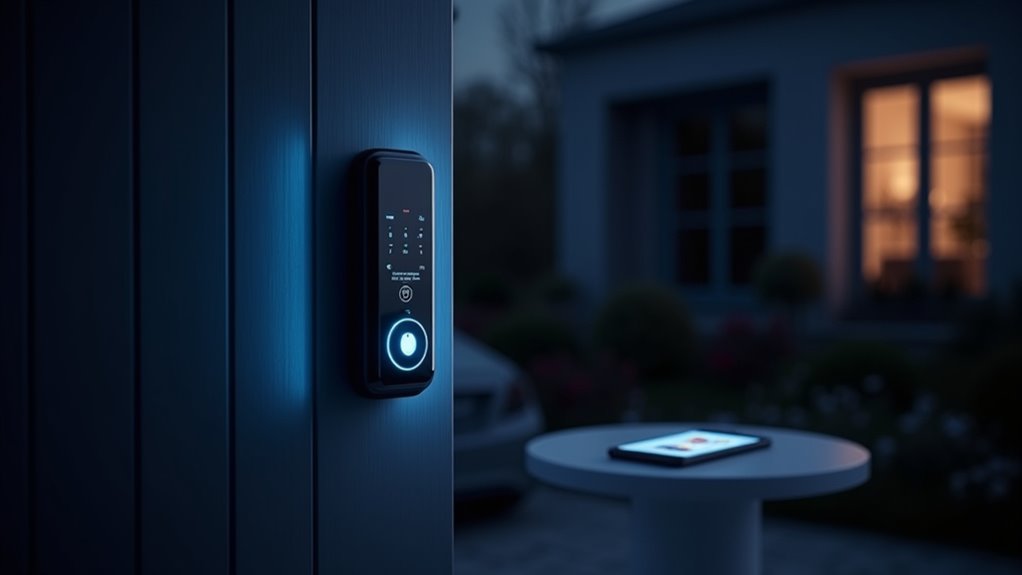
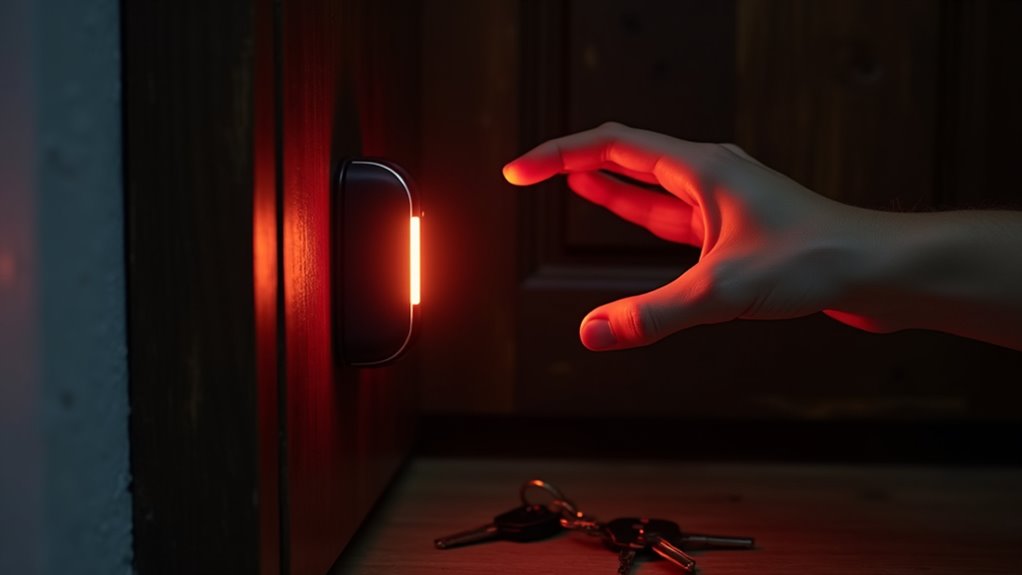
The doorknob is dead. TCL just hammered the final nail into its coffin at IFA 2025 with the D2R Max, a retrofit smart lock that reads your face, palm veins, and fingerprints like some sci-fi security checkpoint. Traditional keys? They’re about as relevant as flip phones now.
Traditional keys are basically stone-age technology now that smart locks read your palm veins.
This thing uses three different biometric scanners to verify you’re actually you. The 3D facial recognition won’t fall for a photo of your face—nice try, burglars. Palm vein scanning supposedly hits 99.9999% accuracy, which sounds basically perfect unless you’re dealing with your evil twin. Authentication takes 0.3 seconds. Faster than fumbling for keys in your pocket, sure, though whether that split-second difference really matters in your daily routine might depend on how much of a hurry you’re always in.
TCL keeps all your biometric data locked down locally on the device itself. No cloud storage, no remote servers, no hackers stealing your palm prints from halfway around the world. At least, that’s what they claim. The AI processing happens right there on the lock, and your privacy stays yours—which feels almost groundbreaking in 2025, even if we probably shouldn’t take any company’s privacy promises at face value anymore. The company swears your data gets military-grade encryption before storage, matching the same security standards they use for preventing spoofing.
Here’s the kicker: you don’t need to replace your entire lock system. This retrofit solution apparently slaps onto most European locks in about 30 minutes. No contractor, no demolition, no drama. Weather-resistant too, so rain, snow, or that weird humidity that makes everything sticky shouldn’t mess with it. Then again, “weather-resistant” can mean a lot of things depending on who’s doing the testing. Unlike wireless alternatives, the D2R Max offers wired connections for enhanced security against potential jamming attacks.
Battery life? Eight months per charge through a standard USB-C port. A gyroscope automatically locks the door when it closes—because apparently we can’t be trusted to turn a deadbolt anymore. Or maybe we’re just that lazy. If the biometrics fail (and let’s be honest, tech fails sometimes), there’s a digital keypad. Plus a mechanical key backup. So much for being obsolete. The lock also supports RFID cards as another access option, because apparently three biometric methods plus a keypad isn’t enough redundancy for some people.
TCL’s D2 series already snagged Best of CES awards and seems to have dominated Amazon’s smart lock sales above $150. The D2R Max runs $169.99. Not exactly cheap, but it’s not mortgage-your-house expensive either. Works with Alexa, sends real-time alerts for unauthorized attempts, handles multiple users with different access levels—basically what you’d expect from a smart lock in 2025.
The smart home evolution keeps churning, and TCL just made regular keys look like stone-age technology. Or at least that’s the pitch. Welcome to the future, where your palm is your password and you’d better hope the battery doesn’t die when you really need to get inside.