How did home security go from clunky alarm systems to AI-powered smart fortresses? Solomon Security in Plano thinks they’ve cracked the code. They’re jumping into a market that’s exploding faster than popcorn in a microwave.
The global home security systems market hit $59.75 billion in 2025. By 2035? It’s racing toward $119.75 billion. That’s not pocket change.
Solomon’s betting big on smart tech—and why wouldn’t they? Smart home security services alone pulled in $37.54 billion in 2025. That number could balloon to $76.78 billion by 2030, though market predictions can sometimes overshoot reality.
Smart home security services hit $37.54 billion in 2025 and could double by 2030.
Still, the company appears to be riding a wave that’s already swept up 94 million U.S. households. Half of all consumers are eyeing security products right now. Not next year. Now. The urgency makes sense when you consider 4,800 to 5,000 fire-related deaths happen annually in the U.S. alone.
Video surveillance is where the real money sits. It grabbed 46% of smart security revenue in 2024. Cameras are everywhere—literally a billion of them worldwide as of 2021. Access control systems are catching up fast with a projected 16.60% CAGR through 2030.
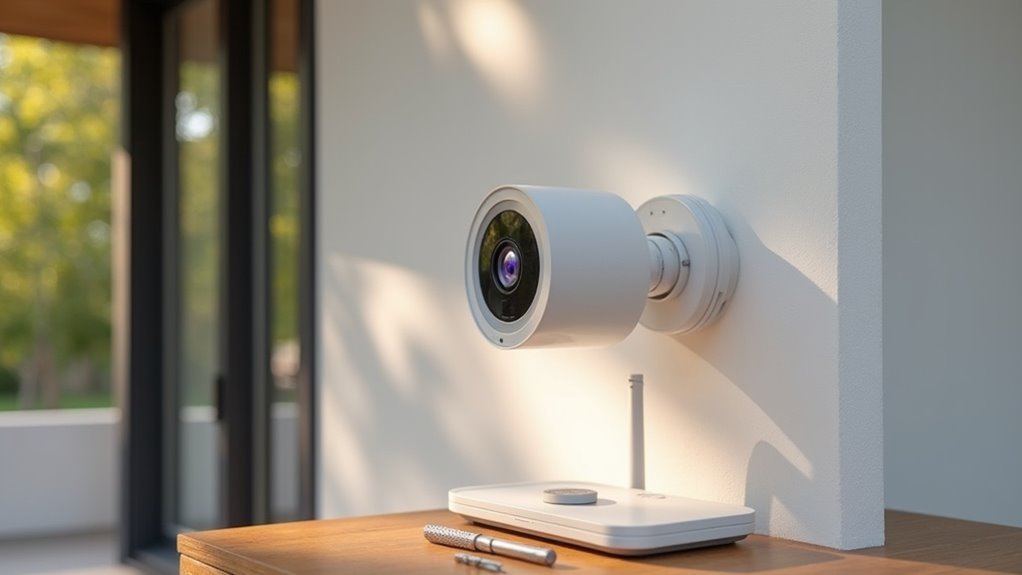
Solomon’s systems pack the usual suspects: cameras, alarms, sensors, smart locks. Here’s where it gets interesting, though. Their AI doesn’t just record; it thinks. Well, sort of. Facial recognition sorts the mailman from the masked intruder—at least that’s the promise.
The system learns your routine, supposedly cuts false alarms, and sends personalized alerts straight to your phone. However, experts recommend WPA3 encryption for all network devices to prevent hackers from exploiting vulnerabilities in smart security systems.
Traditional alarm companies? They must be sweating bullets. DIY installations are growing at 16% annually because nobody wants to wait around for some technician anymore.
Solomon’s wireless kits practically install themselves. No drilling, no tangled wires behind your drywall, no hassle. Or so they claim.
The subscription model keeps the cash flowing month after month. Monitoring services, cloud storage, professional alert triage—these recurring revenues are projected to double to $13 billion by 2030.
Solomon bundles everything: hardware, software, services. One monthly fee, constant updates, zero thinking required.
Whether that’s actually simpler than traditional setups might depend on who you ask.
Even insurance companies have jumped on board. They’ll slash premiums by up to 20% for verified systems—real savings, not marketing fluff.
Though you’d better read the fine print on what “verified” means.
Solomon Security isn’t exactly reinventing the wheel here. They’re just smart enough to recognize that 257 million smart homes worldwide need protection.
In Plano, they’re positioning themselves as the local answer to a global trend. Traditional alarm companies better adapt fast. Otherwise? They’ll likely become as obsolete as payphones.