
While homeowners spend thousands on fancy security cameras, most mount them like they’re hanging Christmas lights. A professional security tester recently exposed how these mounting mistakes turn expensive security systems into decorative paperweights.
The height problem hits first. Mount below eight feet? Congratulations, you’ve given intruders an easy target to disable. Go above ten to twelve feet? Now you’re collecting a stunning collection of scalp photos instead of faces. Cameras set too high only record the tops of heads, missing key identifiers completely. Because apparently, bald spots aren’t admissible evidence in court.
Most homeowners turn expensive security cameras into scalp collectors by mounting them too high to capture faces.
Coverage failures come next. Homeowners obsess over their front door while ignoring back doors, side entrances, and ground-level windows. Garages, basements, and driveways get overlooked entirely. Interior pathways that lead deeper into homes remain unmonitored. Safes and home offices, where the actual valuables live, get zero attention. Back-to-back placement of cameras provides 180-degree coverage without blind spots, but most homeowners never consider this strategic approach.
Then there’s the angle disaster. Cameras mounted parallel to the ground miss faces entirely. Some people create overlapping coverage that’s about as useful as having three cameras pointed at the same doormat. Wide angles compromise detail resolution. Others face cameras directly into sunlight, creating washed-out footage that looks like an overexposed vacation photo.
Location choices get worse. Trees and poles away from buildings? Perfect for creating blind spots and easy camera theft. Meanwhile, natural mounting spots like soffits and fascia areas that protect from weather get ignored. Smart homeowners hide cameras in decorative planters with proper weatherproofing for discreet perimeter monitoring. Unstable mounting surfaces cause cameras to shift, pointing them at clouds instead of intruders.
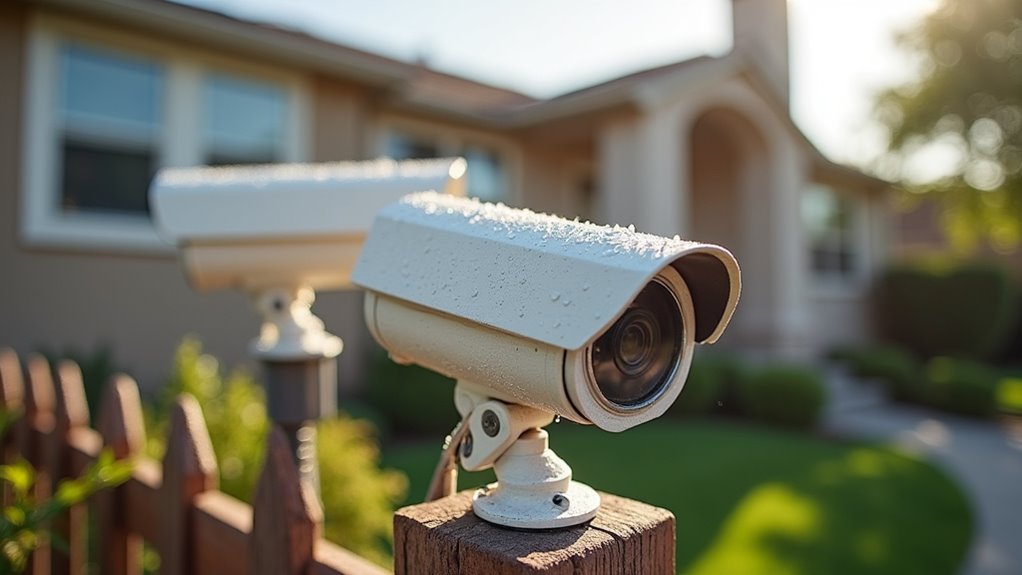
Environmental protection gets forgotten fast. Outdoor cameras without weatherproofing fail when rain hits. No weather shields mean rain droplets and debris obstruct lenses. Temperature swings destroy durability. Condensation buildup and wind exposure require constant maintenance. Vibrating surfaces from loose gutters cause blurred images.
Finally, vulnerability issues multiply. Accessible mounting locations make theft effortless. Weak screws and plastic brackets practically invite tampering. Professional security testers exploit these mistakes within minutes. Wired systems offer significantly enhanced security since they can’t be compromised by wireless signal jamming or interception.
The brutal truth? Most security cameras provide homeowners with false confidence while offering real criminals easy workarounds. Mounting matters more than megapixels.