
Three words explain why smart lighting is taking over: efficiency, control, automation. Traditional lighting systems are dying, and honestly, it’s about time. When Infineon’s smart LEDs hit 90% efficiency while old-school bulbs struggle to break 30%, the math gets pretty simple.
The numbers don’t lie. These LED driver ICs maintain over 80% efficiency even when dimmed down. Traditional systems? They drop to a pathetic 30%. Power Factor Correction pushes things above 98%, which makes regulators happy and energy bills smaller. Green building certifications practically beg for this tech.
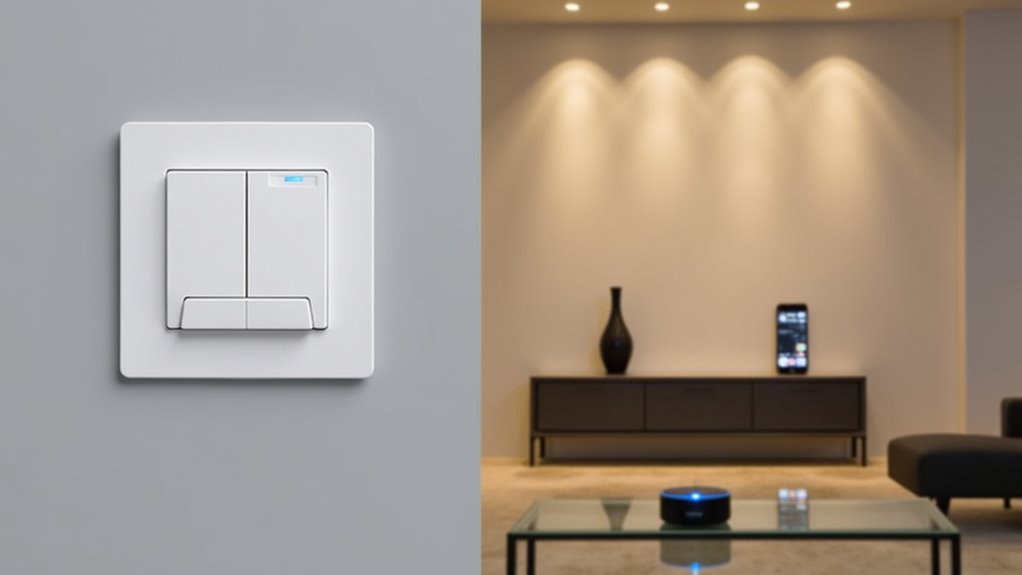
Here’s where it gets interesting. Instant-on capability means no more waiting around like some caveman. Digital soft-start, wireless everything – Wi-Fi, Bluetooth, NFC – it’s all there. Want to yell at Alexa to turn off the lights? Done. The days of wall switches feel prehistoric now.
The days of wall switches feel prehistoric now.
The real magic happens with those 60 GHz radar sensors. They detect motion, presence, occupancy – whatever you want to call it. Lights turn on when you walk in, off when you leave. No microcontrollers needed. The system runs itself, which is perfect for people who can’t remember to turn off lights anyway. These motion sensors operate continuously 24/7, providing seamless automation throughout your home.
These sensors do more than just basic detection. They feed data to serverless cloud functions, trigger AWS Lambda processes, and run predictive algorithms. The lights actually learn patterns and anticipate what users need. Creepy? Maybe. Efficient? Absolutely.
Color rendering beats anything traditional bulbs offer. Full color mixing, complete dimming control, constant current, constant voltage, limited power – pick your poison. The system monitors output in real-time and adjusts as LEDs age. Traditional bulbs just get dimmer until they die.
Infineon’s platform scales from single-room retrofits to massive commercial installations. Modular architecture plays nice with existing building management systems. NFC programming standardizes everything, cutting installation time and reducing errors. At US $0.88 per unit in volume, the economics crush traditional alternatives. The urban farming applications alone demonstrate how versatile these systems are for specialized environments requiring precise light control.
Predictive maintenance through real-time data collection saves money and prevents downtime. Multi-protocol support means the infrastructure won’t become obsolete next year. Traditional lighting can’t compete with this level of intelligence. The transformation isn’t coming – it’s already here, making everything else look like stone-age technology.